From foraging
to thoughtful cultivation.
The documentary by North Spore and 50x50: Science Across America places morels in their natural history and in the history of growers. These key points shed light on the approach.
Different morels, different environments
The film begins with observations in Maine: orchards, declining elms, and living ash trees. The speakers discuss varying relationships with trees. It is therefore important to consider each species and environment, rather than assume that all morels behave in the same way.
The role of reserves
The story revisits an early cultivation patent and sclerotia: structures in which mycelium accumulates resources. Understanding this stage opened new avenues, even though the early processes proved difficult to reproduce.
The move to growing beds
The documentary traces the expansion of Chinese cultivation from 2012, then discusses European and North American experiences. It distinguishes establishing morels in a habitat from managing a crop over time, with control of moisture, temperatures, and protective coverings.
These points summarize the documentary’s discussion. Associations between morels, trees, and microorganisms remain a subject of research; a field observation alone does not establish a universal mechanism.
Explore the history of morel cultivationTerracotta.
A different way to sow.
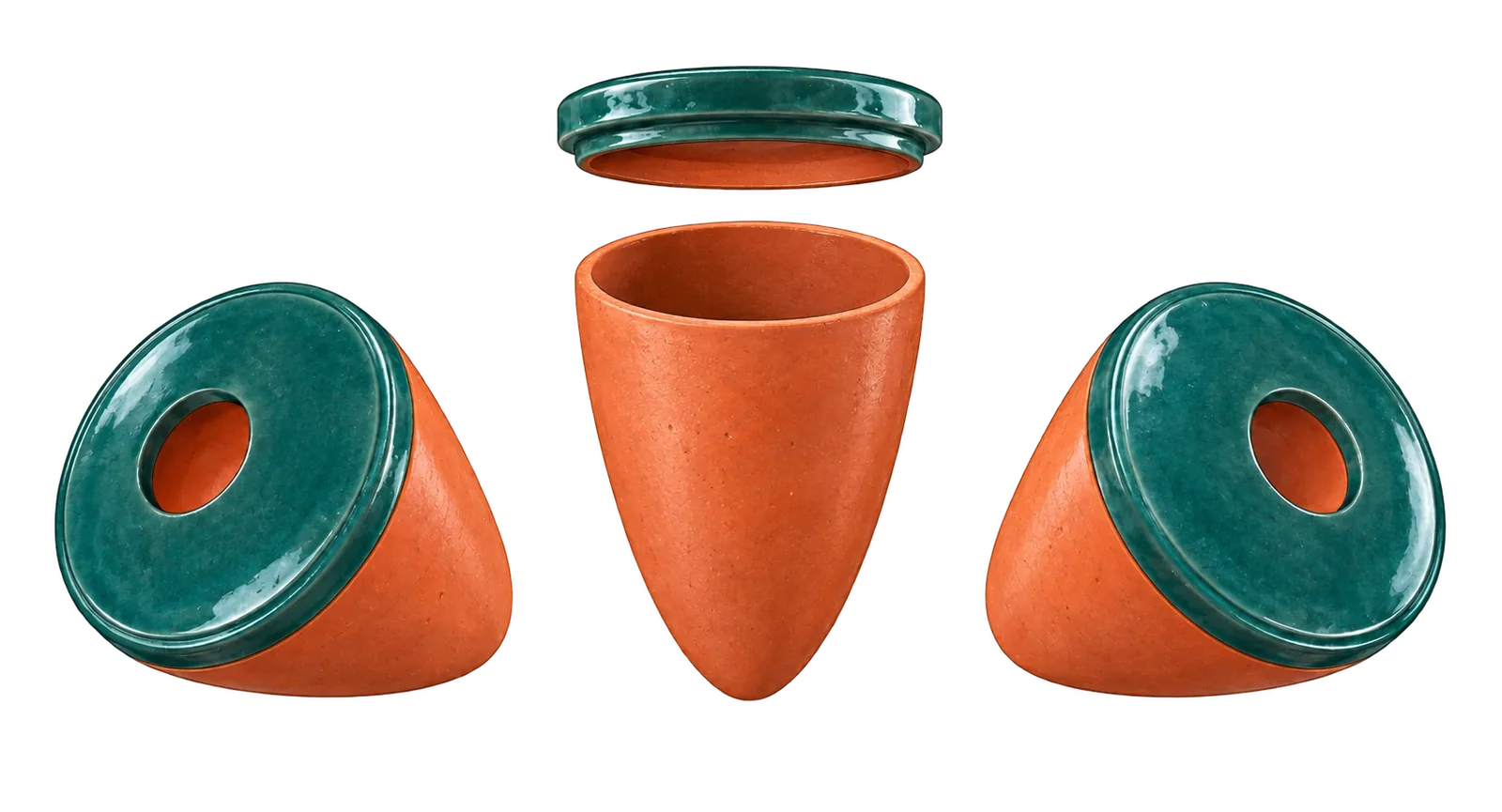
The POD is at the heart of our patented system: a ceramic container that holds mycelium, is installed in the soil, and is recovered at the end of the season.
The North Spore demonstration shows the tapered container, how it is filled, and its green lid with an opening. That opening directs development toward the surface layer of soil. Burial also takes advantage of the soil’s thermal inertia.
The film then shows the soil being moistened before planting, the mycelium being crumbled, and the POD being filled and placed in the ground. The ceramic makes it possible to remove the initial nutrient substrate after cultivation, rather than leave it dispersed throughout the growing bed.
Understand how the POD works in detailA starting point.
An entire season to follow.
At Ceramyca, we see the POD as an interface between mycelium and living soil. The container organizes establishment; it replaces neither site preparation nor ongoing crop management. Attention to bacteria is part of our probiotic approach, whose mechanisms continue to be studied.
The Gardener POD contains its nutrient reserve. It differs from the POD PRO, which is used in a managed growing system with external nutrition. The partnership presented here concerns home growers: for a professional project, talk with Ceramyca about your site and your goals.
Before planting, take time to observe your soil, exposure, and climate. Then support incubation, winter development, and fruiting conditions. Visible colonization is an encouraging stage; it is not a guarantee of a harvest.
Ceramyca expertise.
With North Spore.
For your garden in the United States or Canada, find our partner’s offer under the name CERAMYCA Buried Pod Morel Kit. North Spore is your point of contact for purchasing this home-growing kit.
Order morel PODs from North SporeKit contents, the species offered, availability, shipping areas, and ordering terms: check North Spore’s product page at the time of purchase.
Documentary: North Spore × 50x50: Science Across America. Demonstration: Ceramyca’s Facebook post and North Spore’s YouTube version. The videos remain hosted on their platforms and are credited to their creators.
Continue exploring Ceramyca: the PODs, the guide, and the history.